Hampshire Electronics
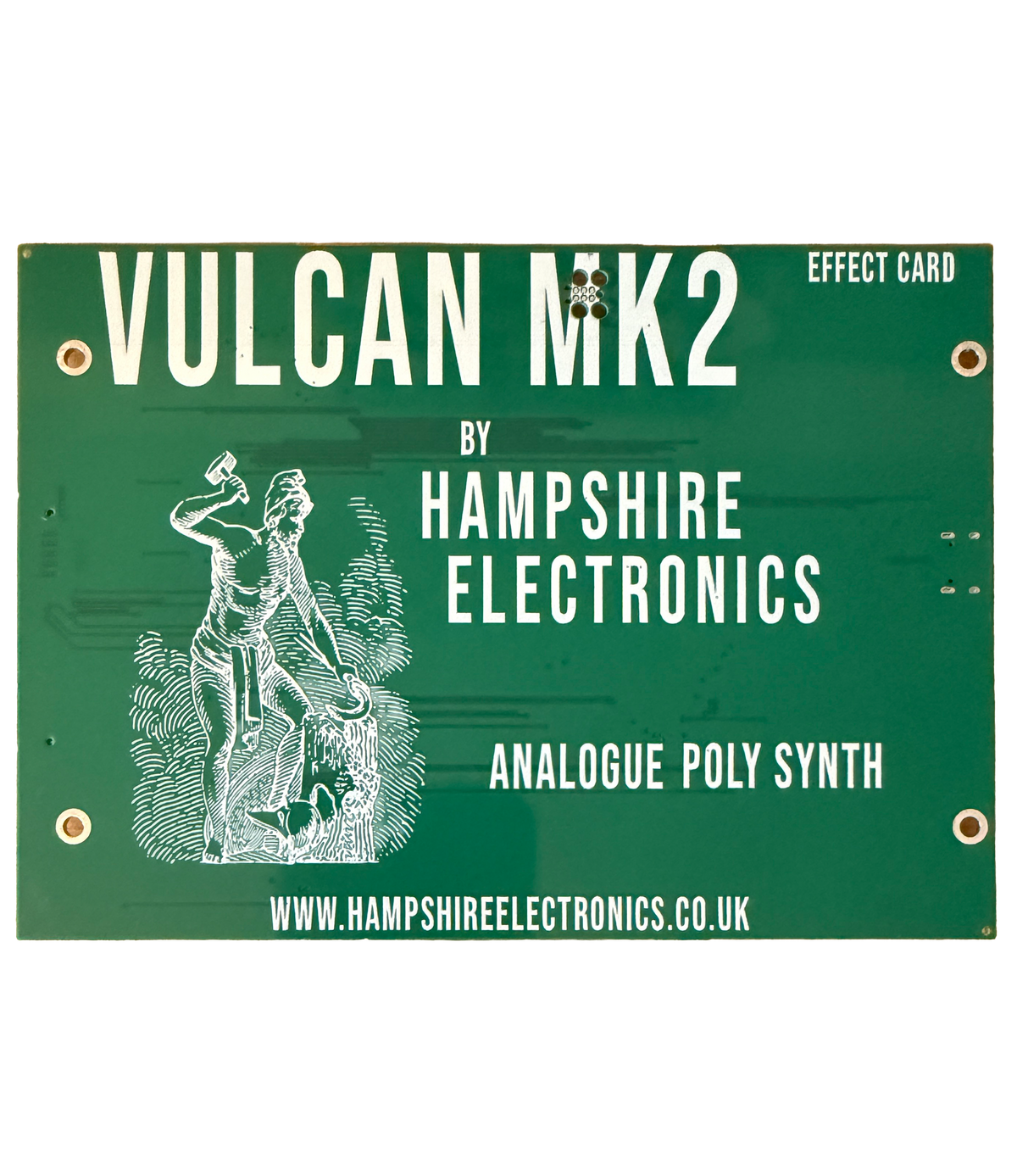
Vulcan Mk 2 Effects Card - Reverb, Delay, Chorus & Granular Expansion
Vulcan Mk 2 Effects Card - Reverb, Delay, Chorus & Granular Expansion
Couldn't load pickup availability
Vulcan Mk 2 Effects Card — Stereo Effects Expansion · Granular, Reverb, Delay, Chorus
Hand-built here in the UK, like the instrument it goes into. This is the optional effects board for the Vulcan Mk 2 — it is not a standalone module and will not work in anything else.
- 30-day no-quibble returns — changed your mind? Send it back.
- Two-year guarantee on every board.
- Faulty in the first six months and we replace it, not repair it.
- Free firmware updates for life.
A whole effects studio, inside your Vulcan.
The Effects Card adds a complete stereo processing chain to the Vulcan Mk 2 — distortion, bit-crusher, phaser, granular, chorus, delay and reverb — on its own dedicated processor, with its own stereo output. It fits inside the module on the standoffs supplied, and Vulcan finds it by itself at the next power-up. There is nothing to configure and no firmware to flash.
Full user manual: Download the Vulcan Mk 2 manual
Its own processor, so nothing is taken from the synth
The card carries its own processor and does not borrow cycles from the voices, so turning everything on costs you no polyphony, no engines and no modulation — the instrument behaves exactly as it did before, with an effects section added to it.
It also has its own stereo output, at EFFECTS L/R. The dry outputs carry on working as they always did, so you can take the clean instrument and the processed one to separate channels and balance them at the desk.
The chain
Audio runs through the card in a fixed order, chosen so each stage feeds the next the way you would patch it: the stereo widener first, then the front-of-chain drive effects — distortion, crusher and phaser — then granular, then chorus, delay and reverb.
- Stereo width — spreads the mix across the field, from mono to wide.
- Distortion — drive from warm break-up to full snarl, with a tone control to voice it dark or bright.
- Crusher — sample-rate reduction and bit-depth crushing, from a subtle grain to decimated crunch.
- Phaser — rate, depth and regeneration, from a slow sweep to a sharp resonant notch.
- Chorus — speed and depth, for width and movement.
- Delay — Tape or Digital. Tape goes out to 9999 ms with softened, saturated repeats; Digital is pristine to 1999 ms. Normal, ping-pong or reverse, with feedback from a single slap to self-oscillating trails.
- Reverb — room to vast hall, with damping, regeneration for blooming decays, and a shimmer control that pitch-shifts the tail as it regenerates.
Every wet/dry control starts at zero, so the card is silent until you reach for it. Nothing changes about your existing sounds the day you fit it.
The granular processor
The granular processor chops the incoming audio into grains and rebuilds it — clouds, smears, stutters and swarms — with control over grain size, density, position in the buffer, spawn timing from strictly periodic through to fully random, and pitch across four octaves. Spray scatters where each grain reads from; Jitter gives every grain its own pitch, so one setting produces a chorus of pitches rather than a transposition. There is a grain arpeggio built in, stepping successive grains up or down.
Freeze holds the capture buffer indefinitely, so the moment you caught keeps playing while you carry on over the top of it. Freeze a chord, then play against it — self-accompaniment from one module, and a superb destination for an envelope or an LFO.
It is part of the instrument, not an effects unit bolted on
Every parameter on the card is a destination in Vulcan's modulation matrix, so an LFO, an envelope, a macro or a CV input can drive reverb size, delay time, grain density or the granular freeze just as easily as it drives a filter.
The PLAY screen gains two pages when the card is fitted, putting the six most-reached controls straight under the knobs — reverb, delay and phaser on one, granular wet, size and density on the other. Without the card those pages are simply not there; Vulcan never offers you controls for hardware you have not got.
Fitting it
The mounting standoffs and screws are included.
Power the module down, fit the standoffs, seat the card on them and connect it, then power back up. Vulcan detects the card automatically and the EFFECTS tile and the two PLAY pages appear. If you ever take it out again, the instrument carries on working exactly as it does without it — every voice, modulation and performance feature is independent of the card.
Specifications
- Complete stereo effects chain: stereo width, distortion, bit-crusher, phaser, granular, chorus, delay, reverb
- Dedicated processor — no load on the synthesiser's voices
- Own stereo output at EFFECTS L/R, independent of the dry outputs
- Every effect parameter available as a modulation-matrix destination
- Two additional PLAY screen pages: Effects, and Granular
- Delay: Tape to 9999 ms or Digital to 1999 ms; normal, ping-pong or reverse
- Reverb: size, damping, regeneration and pitch-shifted shimmer
- Granular: grain size, density, position, spray, jitter, ±2 octave pitch, grain arpeggio, freeze, Fine and Long modes
- Detected automatically at power-up — no configuration, no firmware flashing
- Mounting standoffs and screws included; no soldering required
- Fits inside the Vulcan Mk 2 — adds no panel width
- For the Vulcan Mk 2 only; not a standalone Eurorack module
Taxes and shipping
UK orders: All applicable UK taxes are included in the price shown and there are no additional UK taxes or import charges to pay on delivery.
International orders: Customers outside the UK are responsible for any import duties, VAT, sales tax, customs charges, brokerage fees or other charges imposed by their country of import.
Share