Hampshire Electronics
Vulcan Mk 2 8-Voice Polyphonic Analogue Synth for Eurorack
Vulcan Mk 2 8-Voice Polyphonic Analogue Synth for Eurorack
Couldn't load pickup availability
Vulcan — 8-Voice Polyphonic Analogue Synth System
Estimated shipping end of September 2026.
£50 discount for pre-orders!! Applied at checkout.
£200 deposit, balance payable on despatch.
Full user manual: Download Vulcan MK2 Analogue Poly Synth Manual PDF
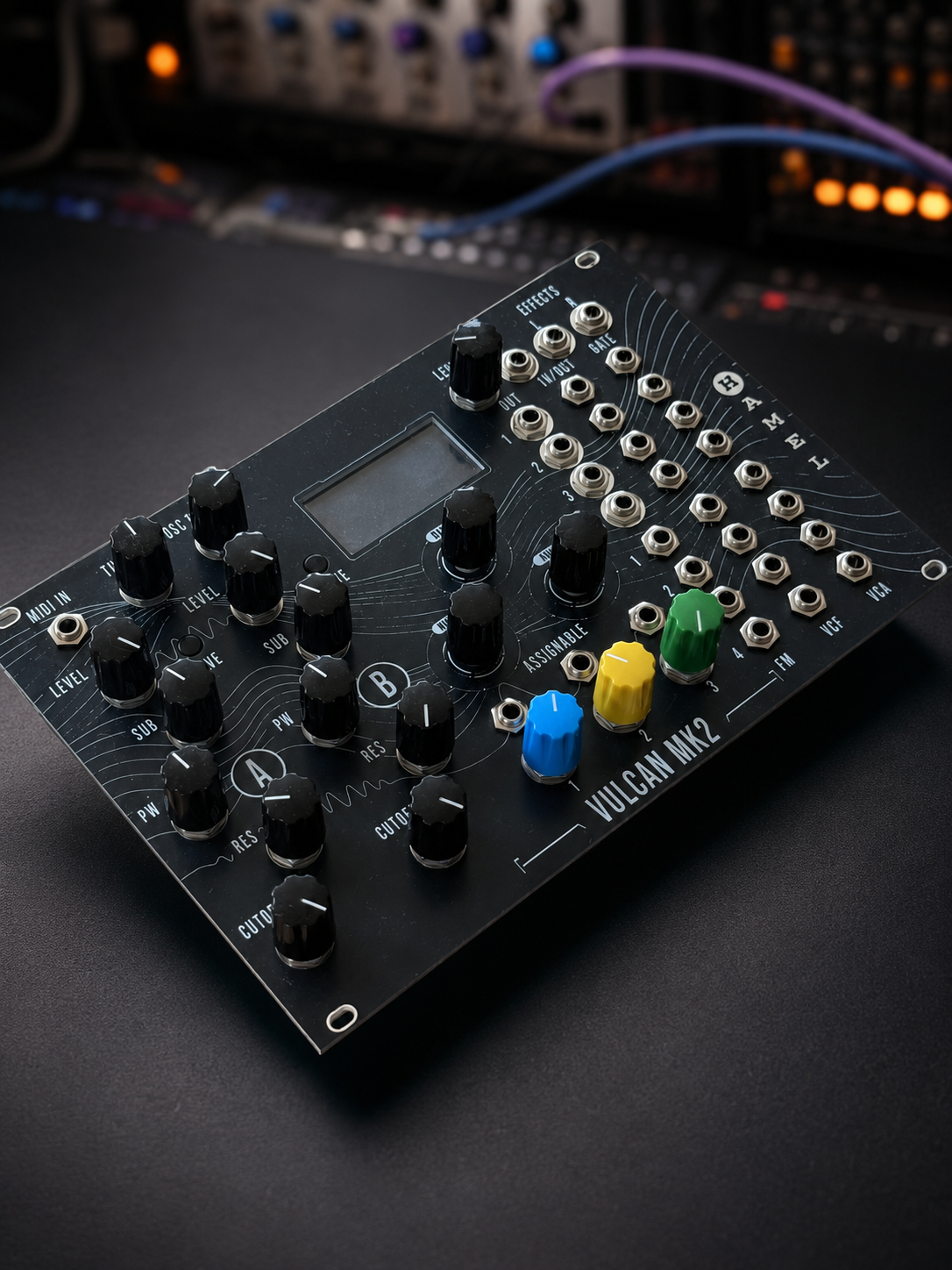
Two complete synths, partnered in one instrument — in just 36 HP. Vulcan is not a hybrid voice. It's a fully analogue polysynth and a modern digital synth, each whole and complete in its own right, built to play side by side. The analogue engine is a 100% analogue signal path from end to end — all the way to the output, with no digital stage anywhere in the audio path. The digital engines are separate, fully voiced synths spanning FM, wavetable, noise and modal and Karplus-Strong physical modelling. Run them together, independently, or layered, and you get the warmth, drift and character of a true analogue instrument alongside the precision and range of a digital one — never one diluting the other.
Choose the system with or without the optional stereo effects board.
A bright OLED display and three dedicated encoders make the deep architecture immediate to navigate, while a full set of dedicated panel controls keeps the core analogue voice under your fingers at all times — because Vulcan was designed as a performance instrument first. Configurable macros and knob / CV binding mean complex sets of parameters can be endlessly tweakable or CV modulated without going near a menu.
Start with eight analogue voices and add the optional effects card when you want studio-grade processing built right in. Vulcan grows with you.
Two Complete Synths, Not a Hybrid Voice
This is the heart of Vulcan. The analogue engine is a genuine, end-to-end analogue synthesise. The digital engines are equally complete synths in their own right. They share a control surface, a modulation system and a performance framework, but their audio paths are entirely separate.
Dedicated Analogue Panel Controls
The heart of the analogue voice is always hands-on — no menu diving for the parameters that shape a sound. Vulcan gives you permanent, dedicated panel controls for both oscillators:
- Per oscillator: Level, Sub mix, Pulse Width, Filter Cutoff and Resonance
- Tuning: Master Tune and Osc 2 Tune
- Waveform: dedicated wave-select buttons for each oscillator
- Three encoders for fast navigation of presets, modulation sources and envelopes
It's an immediate, knob-per-function front end over a deep architecture — tweak the filter, balance the sub, set the pulse width and dial the detune in real time, exactly as you would on a classic analogue poly.
Total Voice Flexibility
Vulcan's analogue array isn't locked to one voice structure. Choose how many oscillators make up a single voice and the polyphony reconfigures instantly:
- 1 osc/voice → 8-note polyphony (16 with the second card)
- 2 osc/voice → 4-note polyphony, with independent Osc 2 tuning
- 4 osc/voice → 2-note polyphony, huge stacked unison
- 8 osc/voice → one colossal monophonic lead
The same hardware becomes a wide poly synth, a fat 4-voice, or a single monster mono — chosen per patch, in seconds.
Analogue + Digital Layering
Every note can trigger the analogue and digital engines simultaneously — two complete synths sounding as one. Lay a glassy FM bell over an analogue pad, reinforce an analogue bass with a digital sub, or detune the two engines against each other for movement that's impossible from a single oscillator type. A dedicated Tune Defeat mode locks the analogue voice to its calibrated pitch so it twins perfectly in tune with the digital engines — no more dialling the tune knob dead-flat by ear.
True Polytimbrality — Addressed Your Way
Vulcan's performance-layer system lets different voices play different sounds at the same time, and you choose how those parts are addressed:
- By MIDI channel — assign layers to separate channels for true multi-part operation
- By keyboard segment — split the keyboard into zones, each with its own sound
- By CV/Gate instance — drive separate parts from separate CV/Gate inputs
Each layer carries its own full patch — analogue parameters, digital engine type, modulation matrix and all. The active layer is always the one your hands are editing live, while every other layer keeps playing from its stored preset, untouched. It's a genuine multitimbral instrument, not a one-sound-at-a-time compromise.
Per-Voice Offsetting & Detune
Fine pitch control runs all the way down to the individual oscillator. Master tune, Osc 2 octave and semitone offsets, and per-voice mirror-group detune are all note-aware — calibrated against each voice's real tuning so an octave shift lands exactly an octave away across the whole keyboard, not an approximation that drifts at the extremes. Add the Age control to introduce fixed, vintage-style tuning inconsistency — from a subtle, living shimmer to a properly loose, "no two oscillators quite agree" analogue character.
Comprehensive CV & Control I/O
Vulcan is built to sit at the centre of a hardware rig:
- 4 × CV/Gate inputs, each with a dedicated 2-oscillator voice — every CV/Gate input drives its own fixed pair of analogue voices (CV 1 → voices 1 & 5, CV 2 → 2 & 6, CV 3 → 3 & 7, CV 4 → 4 & 8), giving you four independent, dedicated CV-controlled voices.
- 4 × analogue modulation CV inputs — hardwired straight to the analogue VCF, VCO and VCA for direct, zero-latency voltage control of the analogue voice. These stay entirely in the analogue domain and never touch the digital layer — pure, immediate analogue modulation.
- 3 × assignable pots and 3 × assignable CV jacks — route to any destination in the modulation matrix or to macro settings, for hands-on tactile control and external CV control of whatever your patch needs: cutoff, FM depth, wavetable position, pitch, mod amount and more. Assignments are saved with every preset.
MIDI Implementation
Beyond the essentials — note handling, velocity as a mod source, and an independent MIDI channel per engine for cross-channel multitimbrality — Vulcan exposes its sound deeply over MIDI, using standard controller assignments so any keyboard, controller or DAW works out of the box:
-
Direct CC control of the core sound:
- Filter Cutoff (CC 74) and Resonance (CC 71)
- VCA envelope — Attack (CC 73), Decay (CC 75), Release (CC 72)
- LFO Rate (CC 76) and LFO Depth (CC 77)
- Mod Wheel (CC 1) as an assignable modulation source
- Program Change → instant preset recall, so you can switch sounds hands-free from a controller, sequencer or set list.
- Pitch Bend with a configurable range, set in octaves and semitones to suit the patch.
- Omni or per-channel operation, with the analogue and digital engines addressable together on one channel or as separate parts.
Because the controller numbers follow the established standard sound-control layout, mapping a hardware controller or automating Vulcan from a DAW is immediate — no learning, no custom maps required.
Deep, Per-Layer Modulation
Both the analogue and digital engines have their own full modulation matrix, stored per layer and per preset. Six shared mod sources — LFOs, envelopes, random and more — are fully bipolar, pushing destinations up and down. Two assignable ADSR envelopes per voice route anywhere in the matrix, with true inverting that pulls a destination down from rest rather than offsetting it. Hardwired VCA and filter envelopes keep the essentials immediate while the matrix handles the rest.
Control "Pickup" — No Jumps
Recall a preset and the panel knobs no longer match the stored sound. On Vulcan, the panel reverts to the saved values and each control simply picks up its parameter the moment you sweep through it — exactly like the pickup behaviour on high-end performance synths. No sudden value jumps, no zipper, no broken sounds when you reach for a knob mid-performance. Every pot can be calibrated to your hardware for accurate end-to-end travel.
Self-Calibrating Analogue Tuning
Vulcan measures and calibrates every analogue voice automatically. A full auto-tune maps each note on each voice for rock-solid pitch across the range, and a fast Quick Tune re-references the voices in seconds before a set or after a temperature swing — so the analogue side is always in tune with itself and with the digital engine.
Expandable Hardware
-
Optional Effects Card — adds a dedicated processor for built-in effects, driven straight from Vulcan's patch system so your processing is part of the sound and travels with every preset.
Power Requirements
Vulcan is a powerful and fully featured analogue / digital poly synth. It requires a good stable power supply and draws the following max current in it's full configuration with optional effects board installed and at full load with all voices active and all effects active:
+12v - 520mA
-12v - 380mA
Vulcan contains eight complete analogue synthesizer voices, additional digital synth voices, optional effects processor, and extensive analogue mixing, modulation and digital control circuitry. A well-regulated Eurorack power supply with adequate capacity on both rails is required. We recommend allowing at least 25% additional power-supply headroom.
All of this in a compact 37 HP Eurorack module.
Share